Image Description
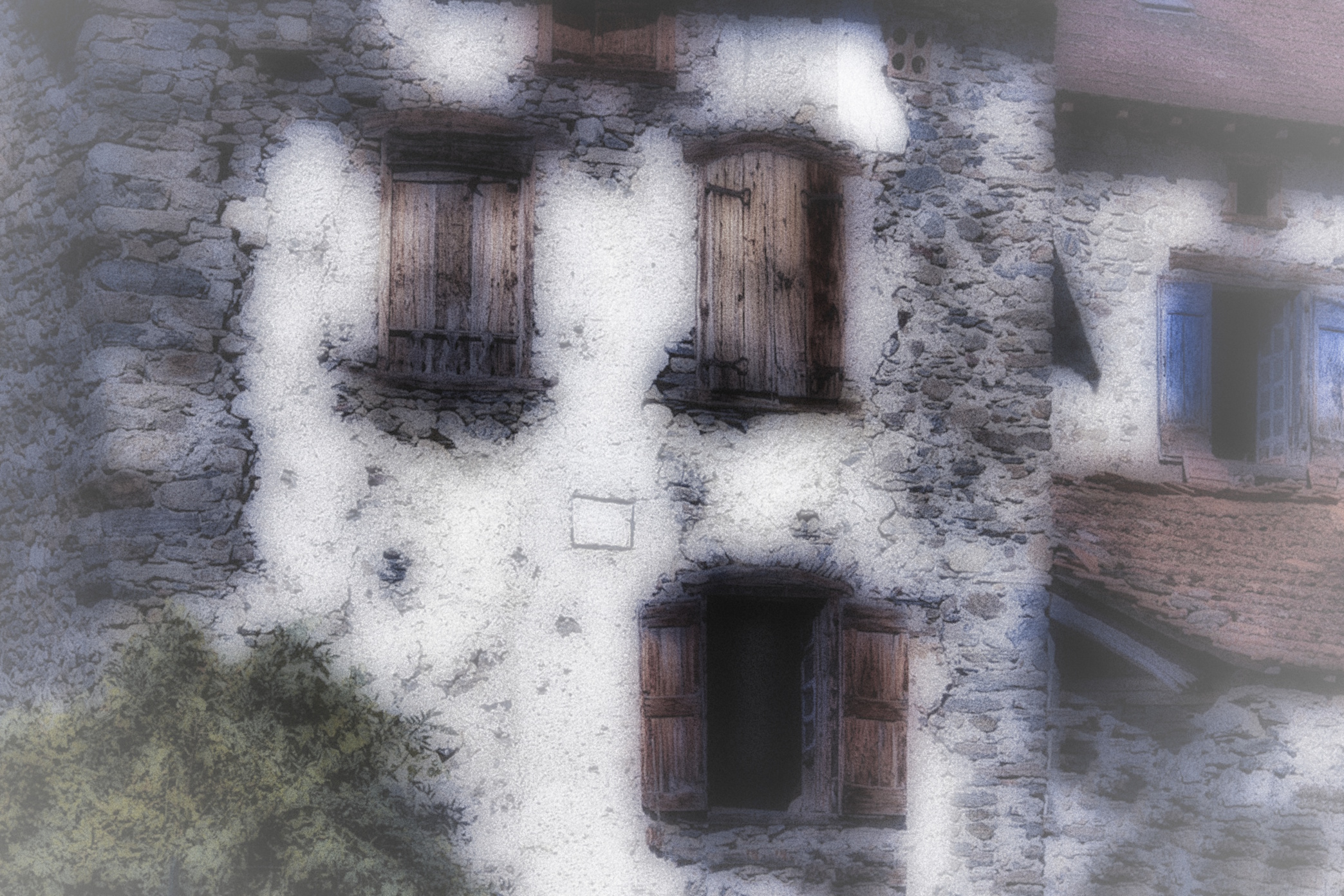
„Fading into Memory“ presents a deliberately impressionistic vision of a Montségur dwelling, where sharp architectural reality dissolves into something more akin to watercolor or remembered dream. The facade, with its three levels of weathered wooden shutters and doorway, appears to shimmer and shift before our eyes, as if viewed through tears or across centuries. Stone and plaster merge in soft gradations of grey and white, while the wooden elements retain hints of their original warmth in muted browns and pinks. The intentional blur creates a painterly quality that transforms photography into something approaching abstract expressionism. Dark openings—windows and doorway—become voids that seem to recede infinitely into shadow. A suggestion of vegetation at the lower left adds organic softness to the geometric structure. This is architecture captured not as it is, but as it might exist in memory: indistinct, emotional, hovering between presence and absence.
Art Critique
This remarkable photograph represents a bold departure from conventional architectural documentation, embracing instead a radical subjectivity that transforms stone and wood into pure emotion and memory. The artist has created an image that exists at the boundary between photography and painting, challenging our expectations of what architectural imagery can convey.
The technical approach—whether achieved through intentional camera movement, long exposure, or post-processing—creates a deliberate dissolution of form that is both disorienting and deeply evocative. This is not failure of focus but rather a sophisticated visual strategy. By denying us the comfort of sharp detail, the artist forces us to engage with the subject on an emotional rather than analytical level. We cannot inventory architectural features; we can only feel the presence of the structure, sense its weight in space, intuit its history.
The composition maintains a classical frontal perspective even as everything else dissolves. The three levels of openings create a facial quality—two eyes above, a mouth below—that anthropomorphizes the structure into a presence that watches, remembers, perhaps mourns. The symmetry is not perfect but felt, emerging from the blur like a half-remembered tune.
What makes this work particularly powerful within the „Echoes of Stone“ series is its formal experimentation. Where earlier images have explored materiality, light, and atmosphere through relatively conventional means, this photograph asks fundamental questions about representation itself. How do we picture memory? How do we visualize the feeling of a place rather than its appearance? The answer, the artist suggests, lies not in clarity but in dissolution, not in documentation but in impression.
In the context of Cathar history, this approach carries profound meaning. The Cathars themselves left few physical traces—their theology was oral, their material culture minimal, their communities largely destroyed. What remains is fragmentary, uncertain, filtered through the accounts of their persecutors. This photograph, with its deliberate imprecision, becomes a visual metaphor for historical memory itself—present but indistinct, felt but not fully graspable, hovering between the tangible and the imagined.
The soft palette of greys, whites, and muted earth tones creates a melancholic beauty that avoids sentimentality through its formal rigor. This is not nostalgia but rather a sophisticated meditation on the nature of perception and memory. The artist acknowledges that all photography is already an abstraction, a freezing of time that can never capture the lived experience of a place. By pushing that abstraction further, by embracing blur and dissolution, the work paradoxically comes closer to emotional truth.
There is something almost musical about this image—it suggests rhythm, repetition, variation on a theme. The vertical elements create visual beats, while the soft focus allows forms to bleed into one another like notes sustained and overlapping. This is photography as improvisation, as jazz, finding meaning not in precision but in feeling and flow.
„Fading into Memory“ challenges viewers to reconsider their relationship with architectural photography and historical representation. It suggests that sometimes the truest way to honor the past is not to fix it in sharp detail but to acknowledge its essential elusiveness, its existence in a realm between remembering and forgetting. This is brave, experimental work that expands the possibilities of the „Echoes of Stone“ series and demonstrates the artist’s willingness to take formal risks in service of deeper emotional and conceptual resonance.
#FadingIntoMemory #EchoesOfStone #Montségur #CatharHeritage #ImpressionistPhotography #AbstractPhotography #FineArtPhotography #ExperimentalPhotography #ArchitecturalAbstraction #ContemporaryPhotography #ArtPhotography #MemoryAndPlace #BlurredReality #AtmosphericArt #OccitaniaPhotography #PhotographicImpressionism #EmotionalLandscape #HistoricalMemory #PyreneanArchitecture #ArtisticVision