Image Description
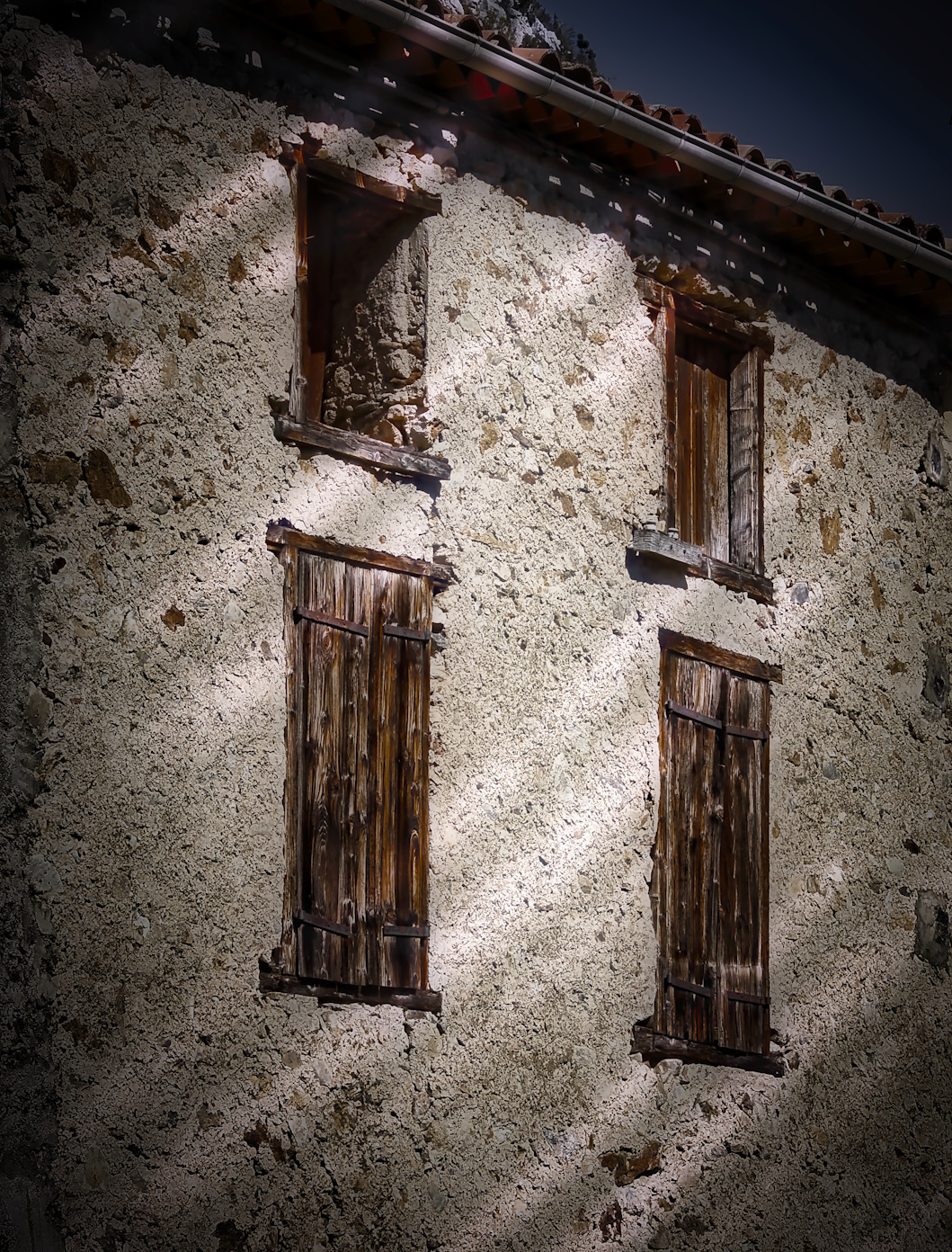
„Witnesses of Silence“ captures the weathered facade of an ancient dwelling in Montségur, a place forever marked by Cathar history. Three wooden shutters, deeply weathered by time and elements, stand like silent sentinels against a textured stone wall that bears the scars of centuries. The harsh midday light creates dramatic shadows, emphasizing every crack, every layer of decay in both stone and wood. The composition is deceptively simple—three rectangular voids that once framed daily life, now serving as portals to memory. The contrast between the rough, porous stone surface and the lined grain of the aged wood creates a tactile quality that speaks to endurance and entropy. This is architecture reduced to its essence: openings in walls, barriers against the elements, witnesses to lives lived and lost in one of the most spiritually significant landscapes of medieval Occitania.
Art Critique
This remarkable photograph transcends architectural documentation to become a meditation on memory, persecution, and the persistence of place. The artist has created a powerful visual statement about absence and presence, using the most minimal of elements—three shuttered windows on a crumbling wall—to evoke the weight of history.
The technical mastery is evident in the handling of light and texture. The harsh, direct illumination is not merely documentary but deliberately expressive, revealing every imperfection, every wound in the stone surface. These imperfections become a text to be read, a chronicle written in decay. The photographer has understood that in Cathar country, every stone carries memory of the persecution that culminated in the tragic siege of Montségur in 1244.
The composition employs a frontal, almost confrontational perspective that refuses romantic distance. We are brought face-to-face with materiality and time’s relentless work. The three windows create a visual rhythm—two below, one above—that suggests eyes and mouth, anthropomorphizing the structure into a silent witness. The closed shutters become metaphors for sealed lips, for stories that can no longer be told directly but must be intuited from what remains.
What elevates this work is its restraint. There are no dramatic skies, no picturesque contexts—just wall, wood, and light. This minimalism forces us to attend to texture, to the specific gravity of stone, to the grain of wood that has weathered perhaps centuries of Pyrenean seasons. The artist trusts the subject matter to carry its own weight, and in this trust creates space for contemplation.
Within the „Echoes of Stone“ series, this image serves as a crucial counterpoint to the sacred architecture. Here we see not the church but the dwelling, not the communal but the intimate. Yet both are marked by the same forces: time, faith, endurance, and loss. The Cathars, who rejected material wealth and sought spiritual purity, would perhaps appreciate this image’s focus on the humble and decaying—a reminder that all earthly things pass, but memory persists in the stones themselves.
This is photography as archaeology of emotion, excavating not objects but the resonance of human presence in landscape. It asks us to consider what remains when voices are silenced, when communities are destroyed, when only walls bear witness to what once was.
#WitnessesOfSilence #EchoesOfStone #CatharHistory #Montségur #ArchitecturalPhotography #FineArtPhotography #RuralArchitecture #HeritagePhotography #OccitaniaPhotography #HistoricalArchitecture #TexturePhotography #MinimalistPhotography #FrenchPyrenees #MedievalHistory #DecayPhotography #UrbanArchaeology #ContemporaryPhotography #ArtPhotography #CulturalHeritage #MemoryInStone